

Zero-Base Design: an idea that borrows from other “zero-base” practices (budgeting, planning) in which we erase all notions of a baseline and start from scratch. While applicable to any design domain, I conceptualized ZBD to address problem-patterns that I have noticed in software development and business process design teams during efforts to execute AI Transformation.
With ai-oriented design concepts and practices emerging, software professionals repeat phrases like AI-First (reminiscent of Mobile-First), human-in-the-loop or human-by-exception. But, these ideas primarily trot out old ideas that worked and tweak them for this moment. When we truly realize (and fully embrace) that we can harness AI to participate among us as an alien mind, and that it thinks like us but in alien ways, we cannot keep dragging our historical thinking into every design.
Consider a project that starts with interviews with people about a process. We document the 85 human tasks, decisions, rules, inputs and outputs. We might slightly optimize the process to 60 tasks through process design and some meager automation steps. But, we build software as user-centric. Just about everything we've been taught and practiced in systems solutions uses language and ideas that root us to how to engage software users in order to help them achieve results. But, even the results get bogged down in outputs (user interfaces to look up and edit data, reports to dig through and find the state of things, completed transactions that support the use case). The idea of outcomes tends to get set on a shelf and noised-out to the point that we struggle not to lose sight of the true objectives.
Simply adding AI agents and chat interfaces to this 60-step, digitalized, user-centric process is a baby step. We can then work on applying AI agents and solutions to attack automation of those 60 remaining human tasks (or some of them) - and we celebrate incremental progress as "productivity gains". How disruptive is this? How revolutionary are we prepared to be?
With zero-base design (ZBD) we start only with outcomes in mind.
- SDLC —> Working Software.
- Procurement —> savings with controllership at scale.
- Sales —> (sustainable) revenue growth.
- Marketing —> mind share growth with growing brand good will.
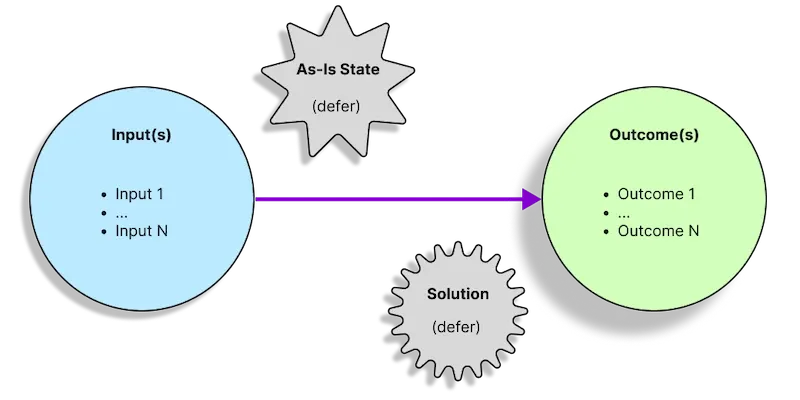
ZB Tuples: Then, we begin to imagine simplest path to outcomes achieved from inputs available. This is a zero-based tuple (inputs on the left, outcomes on the right).
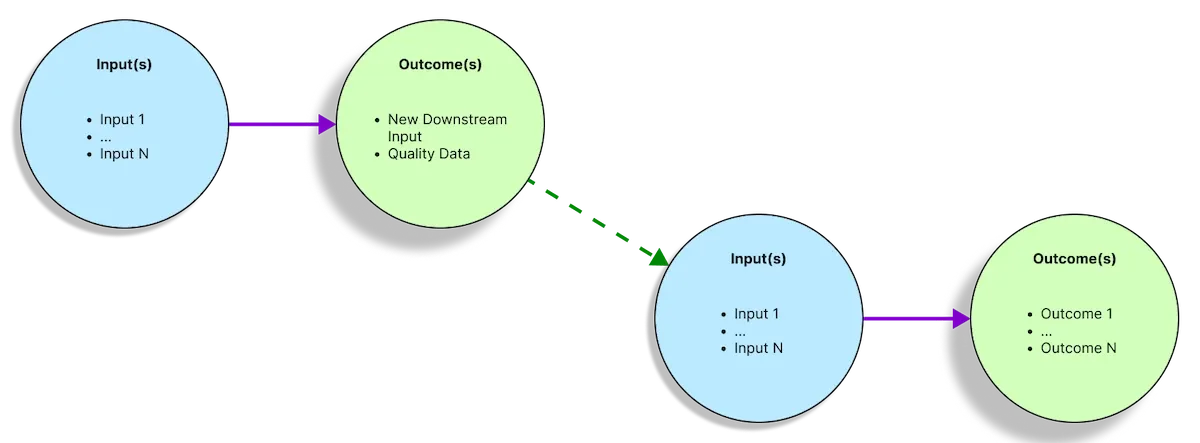
ZB Tuple Graphs: when we test our rightmost tuple to see if we can achieve the outcomes with the resources or inputs available, we may find that our inputs have gaps or quality issues. We then spawn new tuples to the left that are expected to produce one or more necessary inputs as their outcomes. We chain these tuples as nodes in a graph.
Bias Creep: We are guaranteed to let old thinking influence “how” we try to solve for X. We will be tempted to take that 85-step, human-driven, legacy process and decompose it into a ZB-Graph. This is a wrong and self-defeating behavior. Zero-Base means to ignore the baseline, throw out the process, ignore the input forms and reports, close our eyes to the schemas, code bases and paper forms that exist today. We must rigorously fight the entropy of the old to make room for the solution based in primitives that are obsessed with outcomes.
Bias Interruption: This is where concepts like "User by Exception", "Human by Exception" and "UI by Exception" can help us to remember to think differently about solutions that remain focussed on "Outcomes First". We can even add little concepts to help us like "Process by Exception" and"Reports by Exception" to help us think differently. But, like any other "object-destructive" idea that requires us to "Not think about a purple elephant", we remain anchored to old ideas. I prefer "object-constructive" ideas that transport our thinking to the right destination without having to visit old mental neighborhoods. Here are a few object-constructive phrases to help interrupt biases with ZBD for technology professionals.
- Agent-Owned / AI-Owned / System-Owned - assigning ownership and accountability to an AI agent, an AI solution or just to a system.
- Outcome-Anchored / Outcome-Obsessed- the idea of leading with and remaining firmly anchored to outcome-obsession.
- Value-Optimized - the idea of looking at systems, data, processes, people and all other such inputs and resources as optimizable according to self-identified values.
- Why-What-Stop - Start with Why (thanks to Simon Sinek), identify What (outcomes-based thinking) and stop there. (NOTE: The How should be deferred to experimentation, emergence and possibly becomes an unnecessary step in solving a problem. The How can be bought, rented, emergence-captured or AI-brute-forced - so why worry about it.)